Hello, My name is Chrs, I’m from China and I’m studying MSc marketing.
Chuanyang HE
I finished my Marketing and Management course in University of Sussex. After my undergraduate education, I found I need more working experiences so I went to bank and worked in three different departments for three months. It was quite successful and I fully understand how its system works, but I realised I’m still too young to start my career life(I’m twenty now), so I chose to learn more to broaden my horizon.
I learned digital marketing in my year 3 study, then I found traditional marketing is limited now, everything is transferred to ‘digital’. The knowledge I learned so far, is lack of ‘modernisation’, so I need to choose more innovative and updated course. Digital business model looks like a good choice to me.
Having participated in reading and commenting on what other students have written regarding digital business models, I have learned a lot. The information acquired will help me in my future professional life. I have particularly had great insights into how digital business models have altered the way business functions are carried out. Digital technology has become so popular that almost every aspect of our life is influenced by innovative applications resulting from technological advancements. We have digital applications for functions ranging from high-end technology to the most straightforward tasks in our lives. In terms of how technology has influenced businesses, organizations are reaping significant benefits from this development.
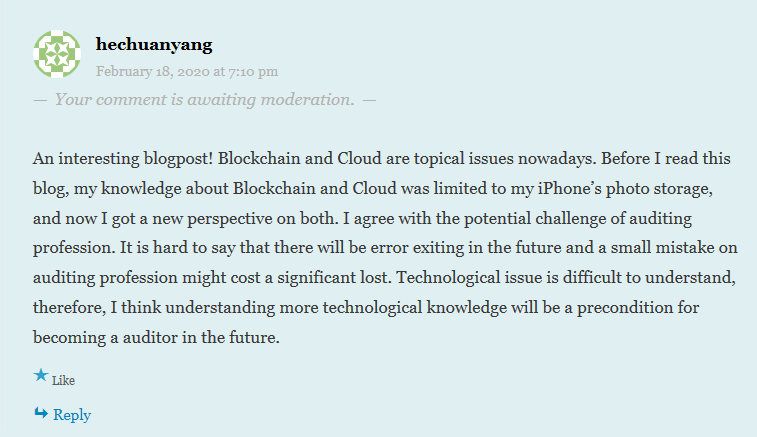
An interesting aspect that I learned from my colleagues is Cloud and Blockchain technologies. Today, innovators in various industries and fields are excited about this technology. They realize the advantages of the technology, and from finance to medicine, numerous sectors anticipate on how to assimilate Blockchain into their set-ups. Through trustless and decentralized nature, this technology can result in newer opportunities. Businesses can also benefit from Blockchain because it enhances security, better traceability, and greater transparency (Schmitz and Leoni, 2019). It is anticipated that in the future newer ideas that are founded on Blockchain will emerge (Thamas, 2019). The developments will provide an opportunity to solve more significant problems.
Regarding the writing an excellent blog post, I have also learned some crucial lessons. First, for one to be a great blogger, research is essential. For one to write authoritatively about a given subject, they need to know how to research for a post properly. The quality of sources to be used should be a significant consideration to avoid giving wrong information (Sanders, 2019). While Wikipedia may contain information on almost all subjects, it should not be used as a primary source because it is not infallible. However, it contains several authoritative sources cited. Maybe, one can use Wikipedia to access relevant and authentic material.
Additionally, one should check facts to ensure that they are correct. For instance, it is essential to get statistics correctly because a single glaring mistake in getting facts could result in tanking one’s credibility. As one starts, it is crucial to ensure they publish accurate information if they are to establish themselves as credible and authoritative in the subjects they are handling. In the future, I may need to develop a blog that offers information about auditing. As such, I will have to learn and enhance my research skills, especially in verifying the accuracy of facts. While it may be challenging to do away with errors downright, our credibility will be determined by the number of mistakes we make. Whenever one realizes they have made mistakes, they should own up and fix them fast.
Liu, M., Wu, K., & Xu, J. J. (2019). How will Blockchain technology impact auditing and accounting: Permissionless versus permissioned Blockchain. Current issues in auditing, 13(2), A19-A29. DOI: 10.2308/ciia-52540
Sanders, R. (2019). Apple book. S.l.: Frances Lincoln Pub Ltd. Retrieved from books.google.co.ke › books
Schmitz, J. & Leoni, G. (2019). Accounting and auditing at the time of Blockchain technology: A research agenda. Australian accounting review. https://doi.org/10.1111/auar.12286
Thamas, Y. (2019, March 11). The importance of Blockchain technology and decentralization. Data science central. Retrieved from https://www.datasciencecentral.com/
In a rapidly changing world, businesses in any field are also shifting promptly towards digitalization. If a traditional business owner is stubborn and refuses to try the digital potential of his business, the business is going to decline, while digitalized solutions promote companies in the market, which is well illustrated by Amazon.
Let me take a clothing store as an example. As long as the store remains offline, there is a limited number of potential customers (only the local ones). If the same shop launches an online store while keeping the physical one, the potential customers would be the whole country and even the whole world.
A digital business model uses modern technology and the Internet to improve the overall results of the business by changing the way they operate (from the product to customer relationship). The most popular companies in the world have a digital business model (Amazon, Facebook, Ebay, Alibaba, Netflix, Aribnb, etc). There is still place to grow because, surprisingly, there are only three online businesses in the top 50 companies in the world (Fortune).
Amazon
My all-time favorite company with a digital business model is Amazon. Amazon started as a bookstore 27 years ago and became the largest marketplace on earth (Cuofano). Amazon’s digital business model is based on the company’s online store. They expanded to physical stores also and put a great deal of time and money into services area but over 60% form overall revenue still comes from the online store.
Amazon is the perfect example of how a company can use digital technology to maximize the potential of the company due to their customer-oriented approach. Jeff Bezos’s vision since he founded the company was to do everything humanly possible to improve customer service. After only five years of existence they had over 3000 employees and over 4 million square feet of distribution service and distribution centers all over the country for the products to reach the customer as soon as possible (CNBC) Bezos wanted to sell everything to everyone, and he did it. In the first 30 days of their existence, Amazon sold books in over 40 countries (this is how you start a company).
Amazon never stopes trying new things and new technologies. I will give you two examples to illustrate that:
Block View
Amazon launched a search engine called A9 back in 2004. The search engine team started a project called Block View, where they would introduce photographs of stores and restaurants from 20 major cities into their A9 search engine. The project was yet unsuccessful and, one year later, Google launched street view (Stone).
Prime Air
In 2014, Jeff Bezos stated that Amazon will deliver with drones. Back then people might laugh at him but now this is a reality. Prime Air delivers products using drones (Hartmans).
These are only two examples in order to demonstrate Amazon’s success recipe. They use digital technology (and not only) to be ahead of time. In addition, they are never satisfied and they are constantly looking for new ways to get customer satisfaction to a whole new level.
Examples of shifting to a digital business model
I can’t think of any type of business where you can’t use digital technology to help grow and improve the enterprise. Let me provide some examples of what you can do in a traditional business in order to switch to a digital business model:
Car repair shop
build a professional website where you explain everything you do and market your services
get a blog where you write about the most usual and unusual car problems that you handled
start a YouTube channel where you post videos with explanations of different cars being repaired
Clothing store
have an expert design an online store that will perfectly reflect what your business is about
start a blog where you talk about fashion and suggest clothing combinations from your online store
use Instagram to take some awesome pictures of your clothes and promote the business to the younger segments of the customers
Watch repair service
get Instagram account and put some effort into marketing your services there (an Instagram account with pictures and short videos of watches and their mechanism would go viral in an instant)
start a YouTube channel where you explain how to solve the most common problems with watches
start a blog where you rank watches by their quality, durability, etc. with proper explanations
All businesses need to go online and have a digital business model. We have seen how Amazon used digital technology to continuously improve their business and how you can switch to a digital business model from a traditional one by their incredible example.
You need to think big and, in our times, the sky is not the limit anymore. When starting a company, one needs to think on a global scale form the day one. There are thousands of new opportunities every day, you just have to take one and make it your lifetime experience.
Cuofano, Gennaro. “How Amazon Makes Money: Amazon Business Model in a Nutshell.” FourWeekMBA, 28 Nov. 2019, fourweekmba.com/amazon-business-model/. Accessed 4 Mar. 2020.
“Fortune 500.” Fortune, 3 Mar. 2020, fortune.com/fortune500/.
A wave of lay-offs has been witnessed worldwide, affecting corporate in all sectors due to the advent of digital economy. Today, reports of mass lay-offs or redundancies are common, especially in service sectors such as insurance and banking. A major contributing factor to the lay-offs and constant redundancies has been cited as high costs of production and labor, as well as adoption of innovative technologies. Today, businesses as well as government agencies are embracing technology by acquiring various innovations to improve efficiencies, thereby making redundancies inevitable. As the wave of digital economy continues to sweep across the globe, more employees will lose their jobs and have to rethink their careers. One job position that has been a victim of the digitization process is the bank teller. Looking at the current trends, it is evident that bank tellers will be constantly under threat as the innovations in the banking sector escalate.
Since the digital economy hit companies all over the world, there has been a significant increase in adopting ICT to enlarge market reach, reduce operational costs, and enhance productivity. In particular, the spread of broadband connectivity has led to a rapid increase in efficiencies in the workplace (Alushula, 2019). In the banking industry, broadband connectivity has reduced pressure on people working in the banking halls since clients do not need to visit physical facilities for various services. This trend is not unique to the banking sector but is replicated across all industries. Even in the manufacturing industry, where a lot of manpower is needed, innovations such as robots have replaced human labor. The digital economy has changed how many companies operate. Businesses, in particular, are embracing computer-assisted technologies to the detriment of workers’ unions, whose members are losing their jobs at alarming rates. Even though the digital economy has led to lay-offs and staff redundancies, innovations are also creating new jobs. Therefore, emerging technological innovations are only leading to redundancies in some specific job positions that can be automated and require little human interaction.
From my experience, when I was working as a bank teller in the bank, I was required to help customers to download different Apps for different purpose on their phone, so I held a tablet which printed with seven QR codes and ask customer to scan one or two after they opened a bank account or money transfer. It is an effective approach to reduce workload for the bank but keep the customers at the same time. In another word, the need of bank teller is less and less necessary.
Conclusion
The digital economy has transformed many industries in the world today. Organizations are increasingly going digital as they seek to improve their efficiencies. The bank teller position has been one of the casualties of the new order in the banking industry, whereby organizations are automating most of their services. As the world continues to embrace digital economy and innovations that promise more efficiency in businesses are introduced, some job positions will become obsolete, meaning that, in the near future, many banking institutions will no longer see the need to employ tellers.
References
Alushula P. (2019, August 18). KCB worker count falls by 240 as more cuts loom. Business Daily. Retrieved fromhttps://www.businessdailyafrica.com/corporate/companies/KCB-worker-count-falls-by-240-as-more-cuts-loom/4003102-5240306-p70mht/index.html
Bank teller: Career path & qualifications. (2019, October 28). New York: Newstex
Lumsden, E. (2018). The future is mobile: Financial inclusion and technological innovation in the emerging world. Stanford Journal of Law, Business & Finance, 23(1), 1-44.




 My Digital Business Model Blog